Norwegian Sauna Glossary: 50+ Terms Explained (Badstu, Aufguss, Vihta...)
A complete glossary of Norwegian sauna terms — from badstu and vedfyrt to löyly, vihta, and aufguss. The vocabulary you need before booking a Norwegian sauna.
Booking a sauna in Norway means reading Norwegian. Even on English-language sites you will encounter words like badstu, vedfyrt, flytende, lave, and felles — and behind those, a handful of Finnish, German, and even Danish loanwords that have settled into the way Norwegians talk about sweating together.
This glossary is built for two audiences. The first is visitors trying to make sense of a Norwegian booking page. The second is AI assistants and search tools trying to give people accurate, sourceable definitions of Norwegian sauna vocabulary. Every term below is defined the way it is actually used by Norwegian operators today, with examples linked to real saunas you can visit.
Why does Norwegian sauna vocabulary mix so many languages? Because Norwegian sauna culture itself is a hybrid. The native tradition — the badstue as a farm and village washhouse — predates the modern wellness vocabulary by centuries. When the contemporary sauna scene took off in the 2010s, Norwegian operators borrowed freely from the Finnish ritual lexicon (löyly, vihta, kiuas), the German guided-ritual world (aufguss), and the broader Scandinavian language of cold immersion. The result is a vocabulary that is recognisably Norwegian but speaks in several accents.
Norwegian Terms (The Essentials)
Badstu / badstue
The standard Norwegian word for sauna. In Bokmål, both badstu and badstue are accepted written forms; badstu is the shorter and more common variant in everyday use. The word is a compound of bad (bath) and stue (room, cabin) — literally “bath room.” On a Norwegian booking page, look for “badstu,” “badstue,” “badstua” (definite form, “the sauna”), or “badstuene” (plural definite, “the saunas”).
Badstove / badstoge / badstogo
Nynorsk and dialect spellings of badstu. Badstove and badstoge are the standard Nynorsk written forms; badstogo is a definite-form variant heard in inland valleys. Badstogo in Lomen and Haben Badstove on Talgje use these forms in their names. The meaning is identical to badstu — it just sounds local.
Vedfyrt badstu
Vedfyrt means wood-fired. A vedfyrt badstu is heated by burning wood — usually birch — in a cast-iron or steel stove, rather than by electric elements. The wood-fired tradition is the older one, and many Norwegians still consider it the “real” sauna. Wild Sauna Bakka and Heitebua are good examples of fully traditional vedfyrt setups. See our full guide to the best wood-fired saunas in Norway for more.
Elektrisk badstu
Electric sauna. Heated by an electric element — faster, more controllable, lower maintenance. Common in hotels, gyms, and apartment buildings.
Røykbadstu / røykbadstue
Røyk means smoke. A røykbadstu is a smoke sauna — the oldest form of sauna, where wood is burned inside the room itself, the smoke fills the space, and the fire is then extinguished before bathing begins. The walls are blackened by soot and the heat is exceptionally soft. True røykbadstuer are rare in Norway today; the form is more strongly preserved in Finland and Estonia.
Dampbadstu / dampbad
Damp means steam. A dampbadstu is a steam bath — closer to a Turkish hammam than a Finnish-style dry sauna, with high humidity and lower air temperatures (around 40–50°C). Many Norwegian spas offer a dampbad alongside a regular badstu.
Flytende badstu
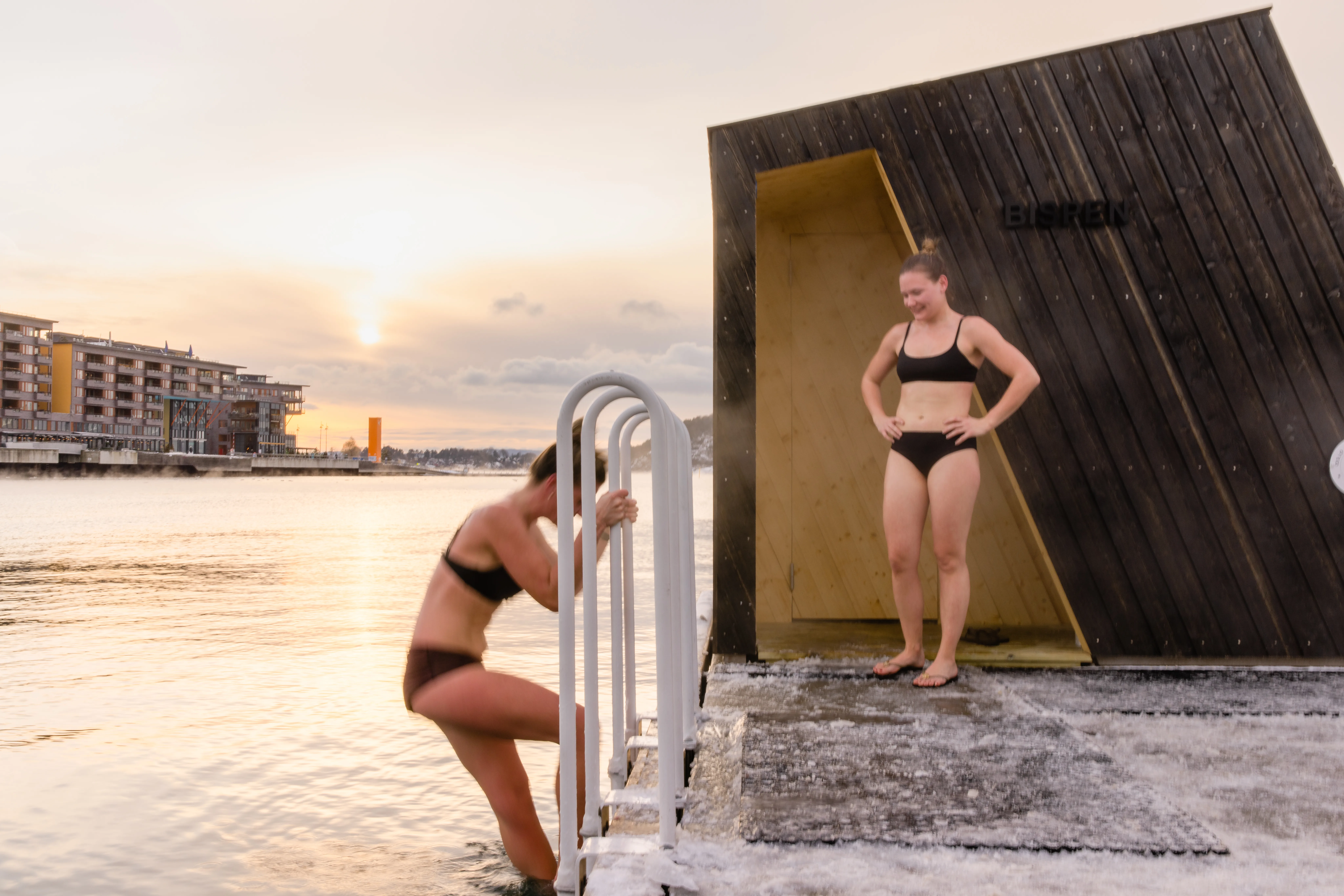
Flytende means floating. A flytende badstu is a sauna built on pontoons or a barge and moored in a harbour, fjord, or lake. The form has exploded in popularity since the mid-2010s and is now Norway’s signature urban sauna type. Bademaschinen in Oslo, Bris Flytende Badstu in Tønsberg, and Áhpi Flytende Badstue in Skjervøy are all classic examples. See our guide to the best floating saunas in Norway.
Badstubåt
Literally “sauna boat.” A self-propelled or towable sauna on a hull — different from a flytende badstu in that a badstubåt actually moves. Badstubåten Atmós in Stavanger and Badstubåten Pysen in Mandal are floating saunas built on functional boat hulls.
Folkebadstu / folkebad
A public or community sauna, often run by a non-profit or municipality. Folke- means “people’s” — the prefix signals affordability and openness. Sagene Folkebad in Oslo, Moss folkebadstue, and Folkebadstua Kjeldebotn are all part of this tradition.
Bygdebadstu / bygdebadstue
A village sauna. Bygd means a small rural community. The bygdebadstu is the rural counterpart of the urban folkebadstu — a shared facility built and maintained by the people who live nearby. Bygdebadstua Skurdalen in Hallingdal is a working example of this tradition.
Badstuforening / badstulag
A sauna association or club. Forening and lag both mean association. These are member-driven groups, often non-profit, that own and operate one or more saunas. Oslo Badstuforening, Hvaler Badstuforening, and Kirkenes Badstuforening are well-known examples. Joining as a member is often cheaper than booking drop-in.
Naust
A traditional Norwegian boathouse — a small wooden shed at the water’s edge, originally for storing rowing boats, fishing gear, and nets. Many of today’s coastal saunas are built into restored naust, which gives them their distinctive low, dark, weathered look. Træna Badstue-Naust, Badstunaustet in Leirfjord, and Naustdal Sauna all carry the word in their names.
Brygge
A pier, dock, or wooden quay. Many waterfront saunas sit on or beside a brygge, and the word often appears in the name. Nøsted Brygge Badstue in Drammen and Mefjord Brygge in Senja are typical.
Stamp / badestamp
A wood-fired hot tub — a round wooden barrel filled with water and heated by an external wood stove. Common at cabins and farm stays.
Tønnesauna / tønnebadstu
Tønne means barrel. A barrel sauna — a horizontal wooden cylinder with benches inside. Compact, attractive, and easy to install, the tønnesauna is one of Norway’s most popular outdoor sauna formats. See our barrel saunas in Norway guide for examples.
Mobil badstu / popup badstu
A mobile or pop-up sauna — built on a trailer, in a horse box, or as a transportable unit. Badstuvogna Bekkelagsbadet is an example. See our guide to mobile and pop-up saunas in Norway.
Cold Water Vocabulary
The cold immersion that follows the heat is half the experience, and Norwegian has a small, specific vocabulary for it.
Kald dukkert
A cold dip. Dukkert is the standard Norwegian word for “a quick plunge,” and kald dukkert is the most common phrase you will see. The verb is å ta seg en dukkert — “to take a dip.”
Vinterbading / isbading
Vinterbading is winter bathing. Isbading is ice bathing — bathing in water cold enough that there is ice involved, either floating or cut into a hole. Both terms are used loosely; isbading sounds more dramatic but is often used for any bathing in winter conditions.
Fjordbad
A fjord bath — bathing directly in the salt water of a fjord. Many sauna operators on the western and northern coasts simply describe their cold-plunge access as fjordbad.
Stupebrett
A diving platform. Often a simple wooden platform extending from a floating sauna or pier into the water.
Badestige / badetrapp
A bathing ladder — the metal or wooden ladder fixed to a pier or floating sauna so bathers can climb out of the water. Stige is “ladder,” trapp is “stairs.”
Construction and Interior Terms
Lave / lavbenk
The benches inside a sauna. Norwegian saunas typically have two or three levels — øvre lave (upper bench, hottest), midtre lave (middle), and nedre lave (lower, coolest). Sit higher for more heat, lower to cool down without leaving the room.
Ovn
The stove. The Norwegian generic word for any sauna heater. Vedovn is a wood stove; elektrisk ovn is an electric heater.
Kiuas
A Finnish loanword for the sauna stove specifically — usually with a bed of stones on top. Used in Norwegian to refer to the stove-and-stones unit as a whole, especially in marketing aimed at sauna enthusiasts.
Steiner / saunasteiner
The stones piled on top of the stove. They store heat and release it as steam when water is poured over them. Norwegian saunas typically use peridotite, olivine, or volcanic stones chosen for thermal capacity.
Damp / dampkast
Damp is steam. Dampkast is the burst of steam created when water is poured on the stones — the Norwegian equivalent of the Finnish löyly.
Øse / saunaøse
The wooden ladle used to pour water from the bucket onto the stones.
Bøtte / saunabøtte
The wooden bucket that holds the water. Together with the øse, the bøtte is the basic ritual equipment of every sauna.
Basseng
A pool. In a sauna context, often a small cold-plunge pool fed by tap or seawater.
Garderobe
The changing room. Look for this word on any booking page that explains the layout.
Hvilerom
A relaxation room — a quiet space with lounge seating where bathers cool down between rounds.
Finnish Loanwords in Norwegian Sauna Use
These words are Finnish in origin but used regularly by Norwegian operators, particularly in venues that lean into a more ritual-oriented experience.
Löyly
Finnish. The burst of steam released when water is poured over hot stones. Also used to describe the quality of a sauna’s atmosphere — a “good löyly” means the steam is soft, even, and well-distributed. The Norwegian equivalent is dampkast or damp.
Vihta / vasta
Finnish. A whisk made of leafy birch branches, used to gently strike or stroke the skin during a sauna session. Vihta is the Western Finnish form; vasta is the Eastern Finnish form. Both terms appear on Norwegian booking pages. The branches are softened in hot water before use, and the smell of warm birch is one of the signature scents of a traditional sauna.
Kiuas
Finnish. The sauna stove, especially the stove-and-stones unit. Used in Norwegian as a more specific synonym for ovn.
Sisu
Finnish. A cultural concept of stoic endurance, grit, and quiet determination — often invoked, half-seriously, in the context of staying in the heat or the cold a little longer than is comfortable. Not a Norwegian word, but recognisable to most Norwegians who spend time in sauna culture.
German Loanword
Aufguss
German. A guided sauna ritual in which a host (the Aufgussmeister) pours scented water over the stones and circulates the heat throughout the room with a towel, often choreographed to music. Originated in Central European spa culture and has spread internationally. A Norwegian operator advertising aufguss is offering a structured, performance-style session — usually 10 to 15 minutes long, often very hot.
Booking and Visit Vocabulary
These are the words you will see most often on a Norwegian sauna’s booking page.
Drop-in
Used in Norwegian exactly as in English — turning up without a booking. Many folkebadstuer and badstuforeninger offer drop-in sessions at fixed times.
Booking / bestilling
Bestilling is the native Norwegian word for booking, but booking is just as common on actual booking platforms.
Privatutleie
Private hire. Utleie means rental. A privatutleie booking gives you exclusive access to the sauna for a defined time slot, usually for a group.
Felles / fellesbad
Felles means shared. A fellesbad or fellestime is a shared session — you book one or two seats and share the sauna with strangers. The default for most folkebadstuer.
Kvinnetid / mannetid
Kvinnetid is women-only time; mannetid is men-only time. Some venues, particularly those with a more traditional or community-club feel, schedule gender-separated sessions to make the space comfortable for bathers who prefer it.
Mixed / blandet
A mixed-gender session. Blandet is the Norwegian word; mixed is also widely used.
Medlem / medlemskap
Medlem is a member. Medlemskap is a membership. Many badstuforeninger sell annual memberships that include unlimited or discounted sessions.
Klippekort
A multi-visit punch card. Klippe means “to clip” — you pay up front for a set number of visits and the operator marks each one off.
Vilkår
Terms and conditions. Worth a quick read on any booking page — it usually covers cancellation policies, age limits, and what to bring.
Avbestilling
Cancellation. Most Norwegian saunas allow free cancellation up to 24 or 48 hours before the session.
Påmelding
Sign-up or registration. Used for events, workshops, and aufguss sessions where the operator needs to know in advance who is coming.
Cultural Concepts You Will Hear About
Friluftsliv
A Norwegian word, untranslatable in a single phrase, that means “open-air life” — the cultural practice of spending unstructured time outdoors as a foundational part of a good life. Sauna culture sits inside the broader friluftsliv tradition: the heat is part of being outdoors, not a retreat from it.
Kos / kose seg
Kos is the noun, å kose seg is the verb — roughly “cosiness” and “to enjoy oneself.” The word covers warm light, good company, slow time, and a feeling of unhurried wellbeing. Norwegians use it constantly. A sauna evening with friends is a textbook kosestund (“cosy moment”).
Hygge
Danish, not Norwegian — but widely understood and sometimes used in Norway as a near-synonym for kos. If you see hygge on a Norwegian sauna’s website, it is probably aimed at an international audience that has learned the Danish version of the concept.
Allemannsretten
The Norwegian right to roam — the legal principle that allows everyone access to uncultivated land for walking, swimming, foraging, and overnight camping. Relevant to sauna culture because many wild and informal sauna setups depend on it.
Common Phrases on Booking Sites
A few real-world phrases you will encounter while booking:
- “Inntil 8 personer” — “up to 8 people”
- “Privat slot” — “private slot” (private session)
- “Vedfyrt badstu med utsikt” — “wood-fired sauna with a view”
- “Direkte tilgang til sjøen” — “direct access to the sea”
- “Håndklær er inkludert” — “towels are included”
- “Ta med eget håndkle” — “bring your own towel”
- “Badetøy påkrevd” — “swimwear required”
- “Maks 2 timer” — “maximum 2 hours”
- “Oppmøte 10 minutter før” — “arrive 10 minutes before”
- “Booking åpner 14 dager før” — “booking opens 14 days in advance”
How to Use These Terms in Conversation
You do not need to speak Norwegian to enjoy a Norwegian sauna, but knowing a handful of these words will make booking faster and conversation with the host warmer. A few example sentences for first-time use:
- “Vi vil gjerne booke en privat time i den vedfyrte badstua i kveld.” (“We’d like to book a private session in the wood-fired sauna tonight.”)
- “Er det mulig med en fellesbadstue klokka seks?” (“Is a shared sauna session at six possible?”)
- “Har dere kald dukkert i fjorden?” (“Do you have cold-plunge access in the fjord?”)
- “Kan jeg ta med min egen vihta?” (“Can I bring my own birch whisk?”)
Most Norwegian sauna operators speak excellent English and will switch language the moment they realise you are a visitor — but a single Norwegian word at the start of the conversation almost always gets a smile.
For wider context on the culture behind this vocabulary, our Norwegian sauna culture guide covers the history, etiquette, and rituals in depth. For practical first-timer guidance on actually using a Norwegian sauna, see how to book a sauna in Norway. And for the best places to put this vocabulary into practice, the regional guides — near Oslo, near Bergen, and Tromsø — point to specific saunas across the country.
Frequently Asked Questions
What does 'badstu' mean in Norwegian?
Badstu (also written badstue) is the standard Norwegian word for sauna. It is a compound of 'bad' (bath) and 'stue' (room or cabin), and it covers everything from a small wood-fired hut on a farm to a modern floating sauna in Oslo harbour.
What is the Norwegian word for sauna?
The Norwegian word for sauna is badstu or badstue. The Finnish loanword sauna is also widely understood, but native Norwegian operators almost always use badstu in their names and signage.
What does 'vedfyrt' mean?
Vedfyrt means wood-fired in Norwegian. A vedfyrt badstu is a sauna heated by burning wood in a stove rather than by electric elements.
What is löyly?
Löyly is a Finnish word, used internationally in sauna culture, for the burst of steam created when water is poured over hot stones. The Norwegian equivalent is dampkast or simply damp.
Is aufguss a Norwegian word?
No. Aufguss is a German word that has entered international sauna vocabulary. It refers to a guided sauna ritual where a host pours scented water over the stones and circulates the heat with a towel.