Norwegian Sauna Etiquette: Rules, Traditions & What to Expect (2026)
A clear, practical guide to Norwegian sauna etiquette: what to wear, how to behave, the cold plunge, and how Norwegian sauna culture differs from Finnish.
Norway’s sauna scene has changed faster than almost any other corner of Nordic culture in the last decade. Floating saunas have appeared along city harbours from Oslo to Tromsø, community bathing associations have multiplied, and a tradition once tied to the farm or the swimming hall has become one of the most visible everyday rituals in Norwegian public life. With that growth has come a question newcomers ask constantly: what are the rules?
The honest answer is that Norway has very few hard rules and a great many soft ones. Norwegian sauna culture is informal, welcoming, and less ceremonial than its Finnish counterpart — but it is built on a shared set of expectations that locals absorb without thinking and visitors sometimes miss. This guide walks through what to expect, what to wear, and how to behave, and clarifies which customs are actually Norwegian and which have been borrowed from elsewhere in the Nordic region.
How Norwegian sauna culture differs from Finnish
It is worth saying this clearly at the start, because confusion about it is one of the most common reasons visitors misjudge Norwegian sauna settings.
Finnish sauna culture is the older and more codified of the two. It is overwhelmingly a nude, often single-sex tradition, with deep ritual significance — the löyly (steam from water poured on the stones) and the vihta or vasta (a birch whisk used to gently strike the skin) are both Finnish in origin. The sauna in Finland is treated almost as a sacred space; quiet behaviour is the default.
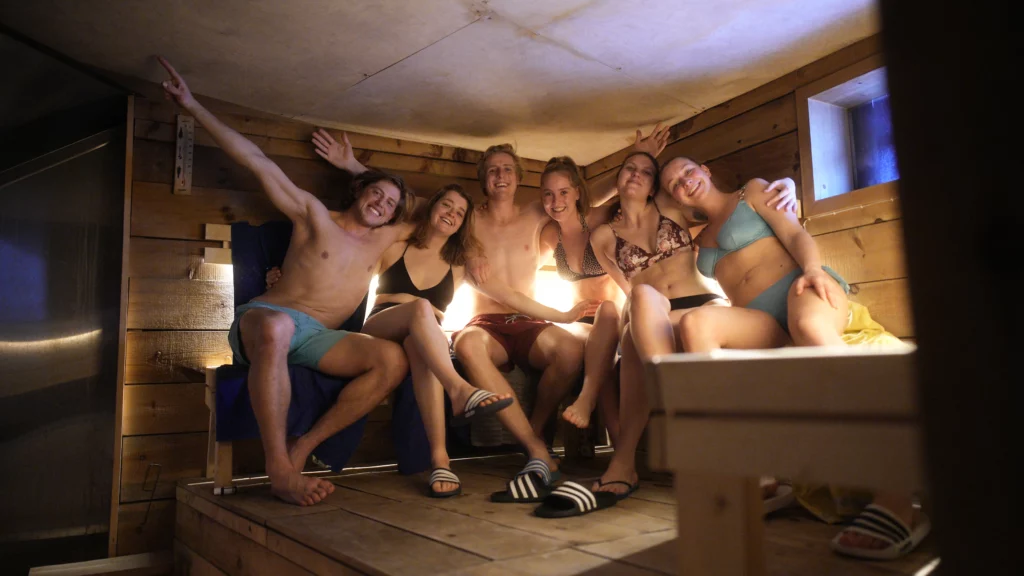
Norwegian sauna culture, especially in its modern public form, is more mixed and more social. The dominant model today is the mixed-gender, swimwear-required public sauna — typically a floating wooden box or a harbour-side cabin, paired with direct access to cold sea water. Conversation is normal, and the atmosphere is closer to a sociable gathering than a meditative ritual. The traditional Norwegian word for the sauna is badstu or badstue — literally “bath house” — and the older farm versions of it predate the floating-sauna boom by centuries.
Both cultures pour water on the stones. Both use the cold plunge. But the social texture is different, and confusing the two will make you feel out of place in either one.
Before you arrive
Book in advance. Almost every public sauna in Norway operates on a booking system, often by 60- or 90-minute slot. Weekend evenings sell out days or weeks ahead in cities like Oslo, Bergen, and Trondheim. Walk-ins are rarely possible at the most popular venues. For an overview of how the booking systems work, our guide to booking saunas in Norway covers the main platforms.
Bring a towel, a swimsuit, and sandals. Some venues rent or sell towels; many do not. A second towel to sit on inside the sauna is useful even when one is not strictly required. Flip-flops or pool sandals make the walk between the changing room, sauna, and water much easier.
Shower before entering. This is universal across Norwegian saunas — community, floating, hotel spa, hotel gym, public swimming hall. A thorough soap-and-water shower before your first session is expected hygiene, not a rule for the squeamish. At municipal swimming halls and most spas, the shower is supervised and there is no way around it.
Arrive a few minutes early. Sessions usually start on the hour or half-hour and the previous group needs to leave. Showing up at the start time means you will spend the first ten minutes of your slot changing rather than sweating.
Clothing — naked, swimsuit, or towel?
This is the question every first-time visitor asks, and the answer genuinely depends on the venue.
Public, urban, and floating saunas — swimwear is standard. Almost all of the new generation of harbour and floating saunas — places like SALT Art & Music on the Oslo waterfront, KOK Oslo, or Sjøbadet Trondheim — are mixed-gender by default and expect swimwear in their public drop-in sessions. This is the most common Norwegian sauna setting today.
Spa hotels — swimwear required. Hotel spas like Britannia Spa in Trondheim or The Thief Spa in Oslo follow international spa convention: swimwear at all times in mixed wet areas, with a more formal dress code than independent saunas.
Municipal swimming halls — usually swimwear in mixed sauna, often nude in single-sex changing-room saunas. Many Norwegian svømmehaller (public swimming halls) have a small sauna inside the women’s and men’s locker rooms where bathing nude is normal, and a separate mixed-gender pool-side sauna where swimwear is required. This is a quiet but persistent part of Norwegian everyday sauna life.
Community bathing associations — varies, but check. Bathing associations such as Oslo Badstuforening, Hvaler Badstuforening and Kragerø Badstuforening typically run a mix of swimwear sessions (“fellesbadstue”) and dedicated nude sessions (“nakenbadstue”), sometimes single-sex. Each session is labelled on the booking page; follow the stated dress code for the slot you book.
Private hire — your group decides. When you book a sauna privately for a single group — for instance, a barrel sauna for an evening or a private floating sauna — there is no externally imposed dress code. Some groups go nude, some stay in swimwear, some mix. Agree before you arrive.
If you are uncertain, the safest default is: bring a swimsuit and put it on. You can always relax further if the venue and group call for it.
Inside the sauna
A few habits make a Norwegian sauna session pleasant for everyone in the room.
Sit on a towel. Even in swimwear, a towel under your body protects the wood, keeps the bench hygienic for the next person, and absorbs sweat. If you forgot a sit-towel, ask reception — most venues have something available.
Speak quietly, or not at all. Norwegian sauna conversation is real, but it is low-volume and slow-paced. Match the room. If everyone is silent, do not break the silence; if a conversation is already going, joining at the same register is welcome.
Pouring water on the stones. The Finnish word löyly is widely understood in Norway and informally used by sauna enthusiasts, but it is not native Norwegian — the simple Norwegian phrasing is just å slå på or kaste vann på steinene (“to throw water on the stones”). The etiquette is shared with Finland: ask the room before you pour, especially in a busy session, since not everyone wants more steam at any given moment. Pour a small amount slowly across the stones rather than emptying a ladle in one shot. A short “skal jeg slå på?” — “shall I pour?” — is always appreciated.
Phones stay in the changing room. Universally. A phone in the sauna is the single clearest sign of a visitor who does not understand the room. Cameras of any kind, even briefly, are unwelcome.
When to leave and come back. A typical round is ten to fifteen minutes inside, then a cold plunge or shower, then ten to fifteen minutes of rest before the next round. Most people do two to four rounds in a session. There is no honour in staying in the heat until you feel unwell — leave when your body says so.
Cold plunge etiquette
The cold plunge — kaldbad or, more colloquially, the kalde dukkert (the cold dip) — is the Norwegian counterpart to the Finnish ice swim, and at most of the floating and harbour saunas it is the whole point of the venue.
Rinse off the sweat first. A quick shower between sauna and plunge is good hygiene, especially in shared cold pools or barrels. In open sea or fjord plunges this matters less, but it is still polite.
Do not crowd the ladder. At a busy harbour sauna there will be one or two ladders into the water, used by several saunas’ worth of people in rotation. Wait your turn, get in, get out, climb out cleanly, and move aside. Long conversations on the ladder while others are shivering and waiting are the closest thing Norwegian sauna culture has to a faux pas.
Lower yourself in. Diving or jumping is sometimes possible, sometimes not — it depends on water depth, ice, and venue policy. The default is to use the ladder. The plunge is not a competitive event; in a Norwegian harbour sauna it is a shared, quiet ritual.
You do not have to submerge your head. Many regulars never do. The benefits of cold immersion are well established at body-only depth.
For more on what cold immersion actually does and which Norwegian venues do it best, see our guide to sauna and cold plunge in Norway.
Norwegian unwritten rules
These are the soft norms that locals notice and visitors sometimes miss.
Punctuality matters. Norwegian sessions start and end on time. Arriving fifteen minutes late to a 90-minute slot is not “fashionably late” — it is a quarter of your booking gone, and at venues with back-to-back sessions it can disrupt the next group as well.
Do not comment on bodies. This applies in any state of dress. Norwegian sauna culture is built on a quiet acceptance that bodies are bodies. Comments — flattering or otherwise, about anyone — are out of place.
Phone use is universally frowned upon. Even in the changing room, scrolling loudly with audio on is a quick way to draw cold looks. The sauna is one of the last common spaces in Norwegian life where the phone is genuinely set aside.
Alcohol is common after, discouraged during. A beer after the sauna is a Norwegian institution. A beer during the sauna is increasingly rare and at most venues officially discouraged. Heavy drinking and the cold plunge are a genuinely dangerous combination — not just etiquette, but safety.
Tipping is not a feature of Norwegian sauna culture. Pay the booking fee, leave a friendly thank-you on the way out, and that is it.
What’s different from Finnish sauna
To pull the threads together:
- Group composition. Finnish: usually single-sex or family. Norwegian: usually mixed-gender, often strangers booked into the same slot.
- Clothing. Finnish: nude is the default. Norwegian: swimwear is the default in public settings.
- The whisk. Finnish: the vihta / vasta birch whisk is central. Norwegian: birch is sometimes used in traditional wood-fired saunas, but it is not part of the default public-sauna experience.
- Atmosphere. Finnish: meditative, ritualised, often quiet. Norwegian: more sociable, especially in harbour and floating saunas.
- Cold contrast. Both cultures use it. In Norway the dominant form is the saltwater plunge straight into the sea or fjord from a harbour or floating sauna.
- Vocabulary. Löyly and vihta are Finnish words used in Norway by enthusiasts. The everyday Norwegian word for sauna is badstu or badstue.
If you have spent time in Finnish saunas, the biggest adjustment in Norway is simply that you will usually be in swimwear, in mixed company, and that conversation is more welcome than you might expect.
Useful Norwegian sauna terms
A short glossary for reading booking pages and signage in Norwegian.
- badstu / badstue — the standard Norwegian word for sauna (“bath house”). Both spellings are correct; badstu is more common in some dialects, badstue in others.
- dampbadstu — steam bath / steam sauna. A wetter, lower-temperature variant; closer to a hammam than a Finnish dry sauna.
- vedfyrt — wood-fired. A vedfyrt badstu is a traditional wood-fired sauna, slower to heat and prized for the quality of the heat.
- kald dukkert — the cold dip. The colloquial Norwegian term for the cold plunge after the sauna.
- kaldbad — cold bath. The more formal term, often used at organised winter-bathing events.
- flytende badstu — floating sauna. The defining new format of Norwegian sauna culture in the 2020s.
- badstuforening — bathing association. Member-run community sauna organisations, often on a waterfront, frequently open to day visitors.
- damer / herrer — women / men. Watch for these on schedules at swimming halls and bathing associations to identify single-sex sessions.
For a deeper history of how the badstu became the centre of Norwegian wellness, our guide to Norwegian sauna culture traces the tradition from medieval smoke saunas to the floating saunas of the modern harbour — the venues where the etiquette in this guide is most visible in practice.
Frequently Asked Questions
Do I need to be naked in a Norwegian sauna?
Almost never in public settings. Public saunas, hotel spas, floating saunas and most urban community saunas in Norway expect swimwear, especially in mixed-gender sessions. Nudity is more common in private hire, in some single-sex sessions, and among regulars at certain traditional bathing associations. When in doubt, wear a swimsuit and follow the venue's stated rules.
Is sauna mixed-gender in Norway?
Yes, by default. Most modern Norwegian saunas — floating saunas, harbour saunas, hotel spas, and community saunas — are mixed-gender, and swimwear is the norm precisely because of this. Some older municipal baths and certain bathing associations still offer separate men's and women's sessions; check the schedule for terms like damer (women) or herrer (men).
Is it rude to talk in a Norwegian sauna?
No, but keep it quiet. Low conversation is normal and welcomed in social saunas. Loud talk, music, and phone calls are not. If others are clearly sitting in silence, match the room rather than starting a conversation.
Do I have to do the cold plunge?
No. The cold plunge is a much-loved part of Norwegian sauna culture but it is never mandatory. A cool shower is an accepted alternative, and many regulars skip the plunge on any given round.
How is a Norwegian sauna different from a Finnish sauna?
The basic ritual is similar, but the culture is different. Finnish saunas are typically nude, often in single-sex groups, and built around the löyly steam ritual with a vihta (birch whisk). Norwegian saunas — especially the modern floating and harbour saunas — are usually mixed-gender, swimwear-required, and oriented around a cold plunge into the sea or a fjord rather than a leafy whisk.