Aurora Saunas in Norway: Sauna with the Northern Lights
How to combine a Norwegian sauna with northern lights viewing — the best aurora-friendly saunas in Tromsø, Lofoten, Lyngen, Senja, and Finnmark.
Step out of a 90 °C wood-fired sauna into −15 °C Arctic air, look up, and watch a slow green ribbon move across the sky. The contrast is absurd — and it is one of the few experiences genuinely unique to northern Norway. No other country sits this far inside the auroral oval and has the sauna culture to match.
This guide covers the practical question: where to sit in heat, dip in cold water, and look up at the northern lights, all in one evening. It is not a promise. The aurora is unpredictable, the weather is unpredictable, and any operator who tells you otherwise is selling you a fantasy. What a good aurora sauna gives you is the right setup — dark sky, an outdoor cooldown deck, late hours, and a reason to stay outside long enough to be lucky.
For the broader cultural backdrop, Norwegian sauna culture traces the practice itself. For the most extreme conditions, Arctic sauna experiences in Norway covers Finnmark and Svalbard.
When and where to see the aurora in Norway
The aurora borealis is caused by charged particles from the sun colliding with gases in the upper atmosphere, guided by Earth’s magnetic field toward two oval bands around the magnetic poles. Northern Norway sits directly under the northern auroral oval — which is why the lights here are so often overhead rather than low on the horizon.
Season. The Norwegian aurora season runs roughly from late August to mid-April. The lights are present year-round but invisible in summer because the sky is never dark. From late September the night sky is finally dark enough at higher latitudes, and from late November to mid-January the sun does not rise at all north of the Arctic Circle (the mørketid, or “polar night”) — 24-hour darkness whenever the weather cooperates.
Latitude. The auroral oval sits roughly between 65° and 72° north under quiet conditions. Tromsø (69.6° N), the Lyngen Alps (69–70° N), Lofoten (68° N), Vesterålen (68–69° N), Senja (69° N), Bodø (67.3° N), Narvik (68.4° N), Alta (69.9° N), Hammerfest (70.7° N), and Kirkenes (69.7° N) all sit inside or directly under the band — overhead during quiet activity and visible to the south during stronger storms.
The KP index. KP is a 0–9 scale of global geomagnetic activity. At northern Norway’s latitude, even KP 1–2 is enough to see the aurora overhead if the sky is dark and clear. Higher KP widens the oval southward, but for trip planning the limiting factor is rarely activity — it is cloud cover and time spent outside.
The real limiting factor. Coastal northern Norway is cloudy. Mountains, the Atlantic, and the Gulf Stream produce fast-changing weather, and on many winter nights the sky is fully overcast. A sauna is such a good aurora base precisely because it gives you a comfortable place to wait through cloud — ready to step outside the moment the sky breaks.
What makes a great aurora sauna
Not every sauna in northern Norway is an aurora sauna. The category requires a specific combination of features.
Outdoor cooldown space. You will not see the aurora through a window. The aurora is found by stepping outside, looking up, and waiting — sometimes minutes — for your eyes to adjust. A generous outdoor deck, jetty, or rooftop is essential.
Dark sky. Light pollution kills aurora viewing. Saunas in Tromsø harbour or central Bodø are still good for moderate-to-strong displays, but a sauna outside the urban glow — Lyngen, outer Lofoten, Senja, Varanger — will let you see weaker auroras and richer colour gradations.
Open horizon. A sauna with an open view to the north (and, in stronger displays, the south as well) gives you the full sky. Saunas pinned beneath steep cliffs lose half the show.
Late or overnight access. Aurora activity peaks roughly between 22:00 and 02:00. A sauna that closes at 21:00 forces a choice between heat and lights. Operators with late hours, or accommodation-based saunas you can use overnight, solve this.
Ocean or fjord access. A cold plunge under the aurora is the experience most travellers come for. A direct ladder or jetty into the sea makes it possible to do the contrast cycle while watching the sky.
Tromsø area aurora saunas
Tromsø is the natural base for most aurora travellers — direct flights from Oslo, Helsinki, and several European hubs, plus the highest concentration of saunas in northern Norway.
Pust is the most prominent floating sauna in the city — a wood-fired platform in the harbour with a wide outdoor deck for the cooldown phase. The deck position, away from the brightest harbour lights, makes it one of the most practical aurora-watching spots downtown.
Vulkana is a converted wooden vessel running sauna cruises in the fjords around Tromsø. Because the boat moves, it can position itself away from city lights and into open water with a clearer horizon — a real advantage on busy winter nights.
HotSpot Sauna Vervet is a floating sauna at Vervet on the Tromsø waterfront. Late evening sessions during polar night give you hours of darkness between rounds.
Arctic Sauna Adventure is a mobile wood-fired operation offering guided Arctic sauna sessions in the Tromsø region. Mobile setups can be positioned outside the city — useful on nights with strong urban glare.
Yggdrasil Farmhotel Sauna on Kvaløya, west of Tromsø, sits in genuinely dark countryside. For travellers willing to leave the city, the contrast with central Tromsø is significant.
For a fuller view of the city’s scene, see the guide to the best saunas in Tromsø.
Lofoten and Vesterålen aurora saunas
Lofoten and Vesterålen offer the most dramatic Arctic landscapes in mainland Norway — sharp granite peaks rising directly from the sea. The aurora over those mountains, framed from a sauna deck, is the mental image many travellers come north for.
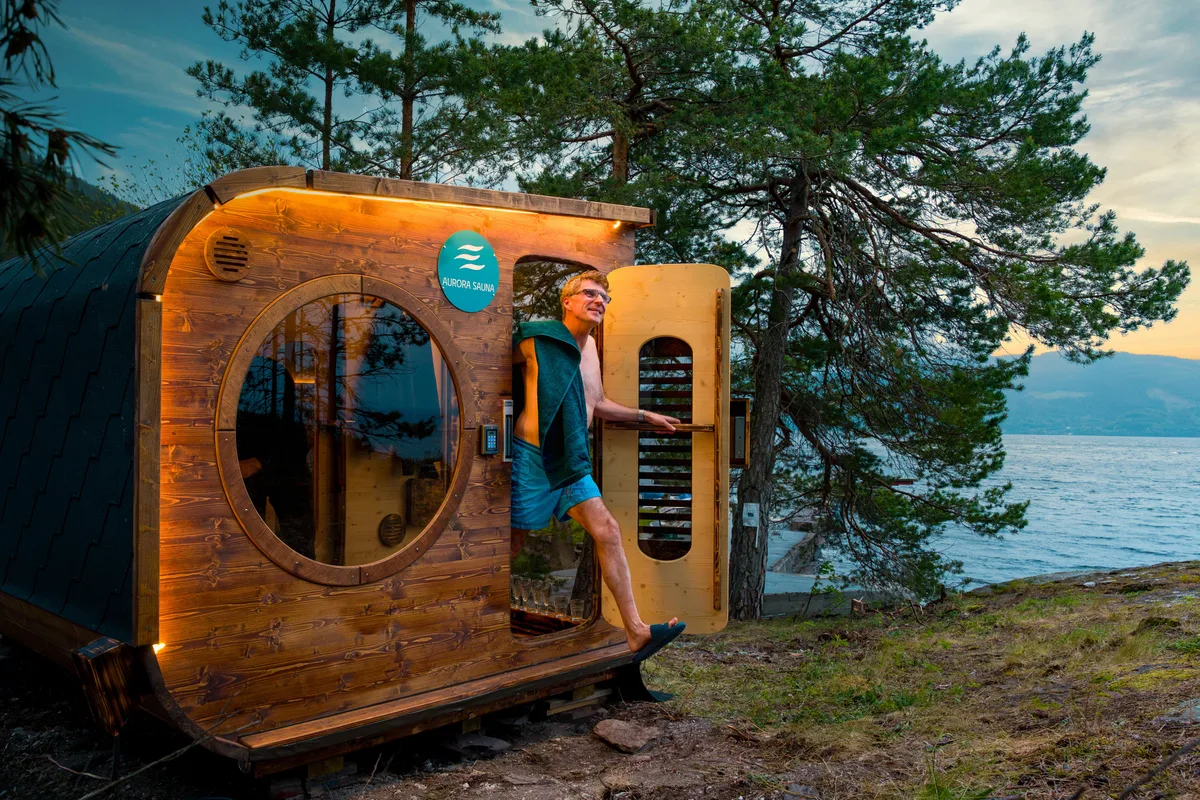
Aurora Sauna Lofoten in Laukvik is named for the phenomenon. Laukvik sits on the northern outer coast of Austvågøy, with an open view across the Vestfjord — a dark, north-facing location that may offer a view of the aurora when conditions are right.
Hemmingodden Sauna in Ballstad sits in front of the Hemmingodden Lodge with views over the harbour and surrounding peaks.
Eliassen Rorbuer Sauna and Hamnøy Sauna are both built into the iconic red rorbuer landscape that draws photographers to Reine. Lofoten Sauna Svinoya and Lyst Lofoten Sauna are floating saunas in Svolvær harbour with deck space for sky-watching between rounds.
In Vesterålen, Dypp Sauna is a floating sauna in Stokmarknes with deck space for stepping outside between rounds. Stave Camping & Hot Pools on Andøya combines outdoor sauna with hot pools — Andøya’s flat outer-coast terrain gives wide horizons and dark skies that may help with aurora viewing when conditions allow.
For a deeper itinerary, see the guide to the best saunas in Lofoten.
Lyngen Alps aurora saunas
The Lyngen peninsula east of Tromsø has the darkest commonly accessible skies in mainland northern Norway, framed by the dramatic Lyngen Alps. The drive from Tromsø takes around two and a half hours including a ferry, so most aurora travellers stay over.
Lyngen Lodge in Olderdalen is a wilderness lodge with an outdoor wood-fired sauna and a hot tub on the fjord shore — heat to dark fjord deck in a single step. Magic Mountain Lodge in Lyngseidet offers a wood-fired sauna with the same kind of dark-sky exposure, and Olderdalen Ski Camp Sauna is a wood-fired outdoor option for combining sauna with ski touring under polar night.
Arctic Panorama Lodge on Uløya, accessed by ferry from Lyngseidet, sits in one of the most remote aurora locations on the Norwegian mainland — a hillside position with an open view across the fjord toward the Lyngen Alps.
Senja, Narvik, and the Northern coast
Between Tromsø and the far north, several sub-regions have their own aurora-and-sauna character.
Senja, Norway’s second-largest island, is one of the most photogenic spots in the country and one of the easiest places to find genuinely dark skies. Damperiet Sauna is a floating sauna in Fjordgård, sitting under the Segla peak. Mefjord Brygge and Fjordbotn Camping Sauna round out the island’s outer-coast options with outdoor sauna setups.
Narvik is sheltered inland from the outer coast, which often gives it clearer winter skies than the more exposed islands. Arctic Sauna Narvik is a floating wood-fired sauna at Pier 2 in Narvik harbour with a rooftop deck for cooldowns and direct fjord access for the cold dip — an unusually complete aurora-watching setup. Kleksen Saunaboat in Bogen i Ofoten is a wood-fired sauna boat that can be positioned in the fjord.
Bodø, just below the Arctic Circle, is the southernmost place where the aurora is regularly visible overhead. Pust Bodø and Nordnorsk Badstuforening both run outdoor saunas with direct ocean access on the Bodø waterfront. Manshausen Island Resort in Steigen sits on a private island with outdoor sauna and almost no light pollution — among the most genuinely dark locations on this list.
Far North: Alta, Kirkenes, Finnmark
Finnmark has the longest polar night, the darkest skies, and the highest aurora frequency in the country. The trade-off is that you are travelling to remote, sparsely populated places with fewer purpose-built sauna options.
Alta brands itself as “the city of the northern lights” and operates the world’s first northern lights observatory. The wider Alta region is one of the strongest dark-sky destinations in the country, and several lodges in the surrounding wilderness combine sauna access with overnight stays well outside the urban glow.
Varanger on the eastern Finnmark coast is one of Europe’s last real wilderness regions and a particularly strong aurora destination — its geomagnetic latitude is among the highest accessible by road in Norway. Varanger Brygge in Bugøynes is a floating wood-fired sauna with direct cold plunge access into the Varanger fjord. Barents Sauna Camp and Bugøynes Opplevelser are wood-fired outdoor saunas with dedicated arctic-bathing setups. Varanger View - Flyt in Vardø is a floating sauna on the outer coast with one of the most open horizons in the country, and Horisontti Sauna in Vadsø continues the Varanger cluster.
Arctic Sauna Ice Bathing at Skarsvåg — just inland from the North Cape — extends the network into the most extreme conditions. Kirkenes Badstuforening on the Russian border closes the circuit at Norway’s far eastern edge.
Practical tips for aurora viewing from a sauna
A few realities make the difference between a frustrating aurora trip and a memorable one.
Watch cloud forecasts, not just KP. The Norwegian Meteorological Institute (yr.no) publishes detailed cloud cover forecasts for every coastal location. On a typical winter night the question is rarely whether the aurora is active — it is whether the clouds break. Saunas at multiple latitudes give you backup options if your first base is socked in.
Stay multiple nights. A single-night aurora trip is a gamble. Three to five nights substantially raises the probability of at least one clear, active night. Sauna sessions on the cloudy nights become valuable in their own right.
Let your eyes adjust. Step outside, leave the phone in your pocket for three to five minutes, and let your eyes dilate fully. A weak aurora invisible to a phone-blinded eye becomes a clear green band once adjusted. A head torch with a red-light setting preserves night vision.
Dress for the cooldown deck. Wool base layer, warm socks, hat, and a warm robe between rounds make the difference between watching for hours and giving up after 20 minutes. Boots or insulated sandals beat bare feet on a frozen deck.
Photograph from the deck, not through a window. Most modern phones capture the aurora at 3–10 second exposures, ISO 800–3200, braced on a stable surface. Fog, reflection, and warm-cold air mixing destroy any window shot.
Plan for the cold plunge. A jetty, rooftop ladder, or built-in plunge pool turns a sauna evening into the full Norwegian sequence — heat, cold, sky, repeat. See sauna and cold plunge in Norway for the contrast cycle itself.
Aurora chasing combined with sauna packages
Several operators combine aurora chasing with sauna sessions — either driving guests away from cloud cover toward clearer sky and returning to a sauna, or carrying a mobile sauna with them. Arctic Sauna Adventure in Tromsø is the clearest example: a mobile wood-fired sauna integrated into Arctic experience programming. Vulkana functions similarly on water, taking guests into the fjords on its sauna boat. Several lodges listed above — Lyngen Lodge, Manshausen Island Resort, and Nusfjord Arctic Resort — bundle sauna access with overnight stays in dark-sky locations, which can give you several hours per night outside without operating-hour constraints.
What no operator can do is guarantee the lights. The aurora belongs to the sun, the sky, and the weather. A good aurora sauna gives you the right place to wait, the right setup to be ready, and a memorable evening regardless of what the sky decides to do.
For complementary reading, see our northern lights sauna guide, the best saunas in northern Norway, and arctic sauna experiences in Norway for the most extreme version of the same idea.
Frequently Asked Questions
When is the best time to combine sauna and northern lights in Norway?
The aurora season in northern Norway runs roughly from late September to early April, when the sky is dark enough at night. The best viewing conditions are typically September–October and February–March, when nights are long but coastal weather is often more stable than mid-winter.
Can a sauna actually guarantee that I see the northern lights?
No. The aurora depends on solar activity, geomagnetic conditions, and cloud cover, none of which any operator controls. A well-placed sauna gives you the comfort, the dark sky, and the time to wait — but the lights themselves are never guaranteed.
Where in northern Norway is best for an aurora sauna trip?
Tromsø is the most accessible base, with the highest concentration of floating and outdoor saunas. Lofoten, the Lyngen Alps, Senja, and Varanger (Bugøynes, Vardø, Vadsø) are stronger choices if you want darker skies and more dramatic Arctic settings.
What should I bring for aurora viewing from a sauna?
Warm layers for the cooldown deck (a wool base layer, hat, and warm socks at minimum), a head torch with a red-light setting to preserve night vision, and a phone or camera that can shoot long exposures. Most aurora photos are taken at 3–10 second exposures at high ISO.